Ad

Sunday, 28 August 2016

You have a part to Play !! 3Rs


Play your part!

Waste materials have been a main environmental problem in this century and the big question is, where does the waste materials end up? Worldwide, communities manage their waste material or garbage differently. Good common methods of controlling waste comprise land filling, recycling as well as composting. Some other communities highly embark on reduction of waste and also prohibiting littering, aimed at decreasing the production of trash products primarily.


Effective and efficient waste administration is best accomplished at home levels.

Often, people need to do the right action but they really they think it is everyone’s duty, and their activities will not make a difference - Incorrect!!

There are countless great people like you who understand the degree of the waste materials problem and they are doing the correct things to assist. But we could do more and also involve others and succeeding.
This is what you can do:


Reduce waste


The next time a person change the waste-bin bag, have a look inside it. Can there be anything that may have not been required to be thrown? Most likely. Try reducing the waste material you generate at home in to half.
Like, Use suitable towels as well as dishes at home rather than paper towels, throw away spoons and also disposable plates etc.
Get your personal shopping handbag instead of buying plastic/polyethane bag each time you go for regular shopping.
Utilize old article package containers/boxes for parcels rather than purchasing fresh one.


Re-use things that end up being waste


You will find things that may be used over and over again: bundle boxes, present wrappers, clothes, furniture as well as playing playthings. If actually you think it is beyond use, you are able to give it to be able to someone who has a purpose for it. Ponder before throwing anything.


Re-cycling of waste

You can also think about sorting out the actual waste with regard to recycling as well as composting. See this video on garbage management.


Take a Lead or Join for an Environment activity group

Many people live in interests that have absolutely NO garbage or waste management programs. This is a good time for you to start or even join the activity that may push with this kind of support. Let's Clean the Earth

Related article (Hindi) :

पर्यावरण-संरक्षण के कुछ उपाय
घर से करनी होगी पहल
बढ़ रहा प्लास्टिक वेस्ट
घट रही जिम्मेदारी
वृक्षारोपण का महत्व
वर्षा जल संचयन

by CGAN

Tuesday, 23 August 2016

Tips on how to Transplant Shrubs and trees: Step-by-Step Guidance

Transplantation trees and shrubs would seem an easy task -- so mistaken. Much relocation of trees die out as a result of improper removing or setting up. But if you tend to provide a makeover to your landscape style that has been ignored for years, you’ll need to shift existing trees/plants, either through replanting or disposal. To obtain successfully result, you need to take steps to further improve the chances of your survival. Learn the simplest way to move plant life, as well as the appropriate time to do so.


Tips on how to Transplant Shrubs and trees: Step-by-Step Guidance

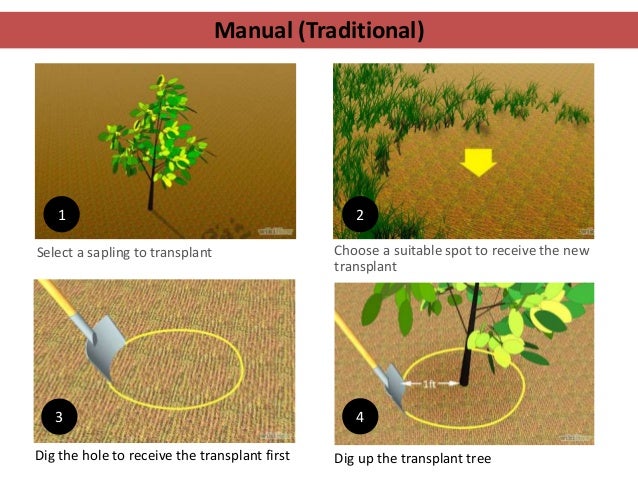
  1. Consider the maximal - "Place or Location”. Prior to re-planting or transplant, determine whether the tree or plant favour sun or shadow, and what exactly its space and water requirement are. As an example, do not choose a plant that will craves water next to the one that prefers dried conditions : the requirements will be incompatible.
  2. Get the new pit dig before you dig out the tree/plant for transplant. Once you dig out the plant, often the longer it has the roots head out without a ground, the lower the odds for survival of transplanting will likely be.
  3. Determine or calculate the size and detail of the root-ball. The actual width from the new pit should be two times that of the actual root-ball. Often the depth must be kept somewhat shallower, to prevent pudding as well as consequent aging (especially in case your soil is clay-based).
  4. After digging, whenever you reach the base of the new hole, DO NOT break in the soil underneath. You would feel that this would help the tree or perhaps shrub, enabling its root base to enter deeper. Rather, it could trigger the woods or plants destroy and invite decay.
  5. Seek out the plant chosen for re-planting. But do not begin digging at the base of the fully developed tree / plant. Relatively, begin digging about three or more feet out of the base, all of along the circumference. Get a sense for the location where the main Size of Root beginning lies. Additionally begin to determine what the body mass will be of the plant as well as the roots in addition to the soil adhering to root base. You may need anyone to help you raise it.
  6. The concept is to maintain as much of the actual root-ball (roots plus soil) intact as you can. Nevertheless the larger plant is, the probability of getting something close to the complete root-ball may reduce and you will not be able to put it anyhow. Typically you will have to trim through several roots of the older plant. Make sure to make a great, fine cut.
  7. After you have removed sufficient soil through around the edges of the plant, you will finally be able to slide your spade (scoop) under this and begin to loosen the actual plant's grasp on the ground below it. After soil is loosen, spread a tarp (cover, sheet) on the ground very close by and softly move the particular tree or shrub on to the sheet.
  8. While using tarp as being a carrying method, move the plant over to the new dug pit (steps 1-4). Carefully shift it to the hole, and place it upright. Put back the actual unearth soil back into the opening and fill it. Stamp this particular soil straight down firmly as well as water it, to get rid of air sack. The development of air flow pockets might lead to the tree or plant to shift it position and loosen it grip on the ground.
  9. Pile up the earth in a group around the newly shifted tree or plant, forming the sink which will hold water like in a container. This will assist you to achieve your primary objective to get the newly relocate roots nicely watered, until it finally becomes settled.
  10. Get spread around a 1-2-inch layer of manure towards newly relocate tree.  But maintain it a few long away from the ground trunk, to promote air flow and also not to invite rats/pest with gnaw over the trunk.
  11. Next very important task is to only Water. The initial summer would be a difficult for the tree to fight the weather condition, provided the tree gets a lot of water. For any tree transplant, Watering is one of most vital step, to make any transplanted tree survive and get success.

Best time to Plant or Transplant a Tree/Plant

It is recommend from June & upto Oct-Nov for planting any sort of tress particularly in India. Monsoon will help but one must be willing and ready to water.  
Reason:  1. There is certainly sufficient rain water to take care of the trees.
              2. The temperatures is also reasonable and does not burn off the new plant/tree
              3. It develops adequately in order that it can survive the harsh summer time.

As far as the Climate in India, one plant trees any time provided sufficient water is available. So do not delay or postpone tree plantation.

Your plant matters, but how you plant and quality of saplings matters as well. 

By CGAN

Saturday, 20 August 2016

Best Trees to Plant with Indian Origin

Trees and shrubs in Indian are known for their elegance and amazing beauty. Trees in India undertake the fundamental position within the heritage associated. Forest, trees have always been related to  the quality of being wise as well as quality of being immoral in India. Indio literature explains a divino tree as having its origins in the paradise and its divisions in the underworld that combines and links with each kind of living beings. 

The Indian subcontinent is shedding its environmentally friendly cover and it is know fact now that many of us have to do a good deal in making on with it. Yet it's very good to know about the plant life which grows inside our country. You'll be astonished to know the fact that India houses a large variety of trees. Though it was not possible to compile them all, we will discuss few prominent trees that we all see close to and don't realize much concern.

Banyan (also known as Bodhi Tree) being India's National Tree, nevertheless Peepal, Tulsi and Indian Rosewood, Kikar, Ashwagandha, Brahmi, Sal, Asparagus (Shatavari), Khair, Cork, Aleo Vera many others also are some handful of the plants and trees that contains special ethnic and non secular significance throughout India.  

Banyan Tree
Banyan tree


Banyan tree (India's National Tree) is a very familiar sapling in the land of Buddha, India. Surprisingly, had originated in this subcontinent by itself. These types of trees possess the largest coverage within India. It is really a large and giant tree addressing several hectares with extensive divisions of branched and roots. The actual leaves tend to be broad, square and shiny. It is a ageless and classic tree lives 100 of years. Indians call it a wish fulfilling tree. Bargad, Bar, Vad, Vatnam, Bahupada, Peddamarri, Al are the other names used for the Banyan tree. 

Peepal Tree

Peepal tree
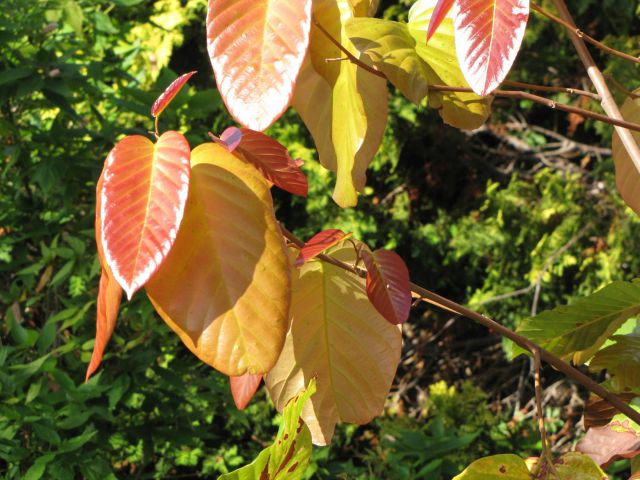
Peepal is a substantial, fast rising deciduous (a sapling or bush shedding her leaves annually) tree. It has a heart designed leaves. The tree has a large overhead with the fantastic wide distributing branches. This shed its leaves in March and April. Its bark is usually light greyish and peels in sections. Its berry is pink in shade also called as Fig. It is on the list of longest dwelling trees. Beepul tree, Pipers, Pimpal, Jari, Arani,Ashvattha, Ragi are the other names used. It is one of those exceptional trees which release breathable oxygen both in the morning and the nighttime.

Neem Tree
Neem Tree

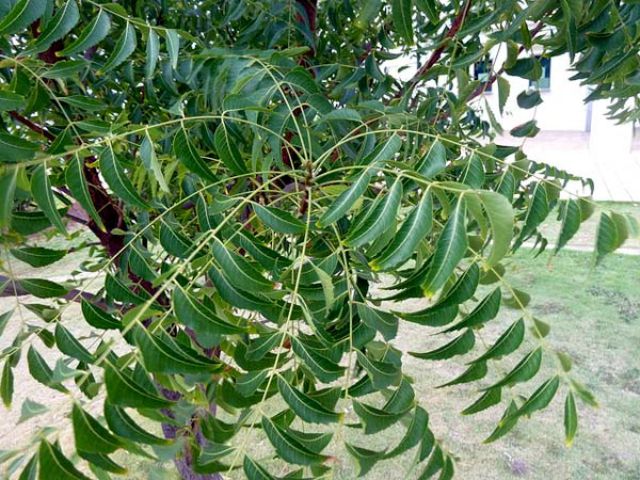
Neem trees are grown in the tropical plus sub-tropical parts. It is a tall classic tree having small vibrant green simple leaves. It blossoms around spring period with full of small whitened flowers.  The bark of the neem tree is hard & tough and scaly, have cracks also in small size trees and shrubs. The olive like harmless fruit are oval, circular and slim skinned. Neem offers endless therapeutic properties and that’s why is it a well-known tree in India. It is utilized to control unwanted pests and cope with pox infections etc. Neem is really a major component in cleansers and is healthful for our pores and skin. It is also known as Nimba and "Arishtha" (an ancient name) that means the reliever of the disease, in the Indian subcontinent.  
Arjuna Tree

Arjuna Tree

Arjuna is a big size deciduous tree wood. Terminalia Arjuna tree is normal grows throughout Indian especially in the lower part of Himalayan areas and far eastern India. 

The peak of the Arjuna tree gets upto 70-100 ft. It is the classic tree using the yellow blossoms and conical leaves and has a very low smooth grey bark. Within the buttressed trunk area and a huge spreading overhead from which the actual branches bend downward. Arjuna displays yellow blooms from March till June. It has a hard woody fibrous fresh fruit that seems between Sept and November. The particular woody fruit has several wings and is also possibly the most unique of its kind. The other names used are Arjuna, Koha, Kahu, Arjan, White Marudah, White Murdh

Sal Tree

Sal tree

Sal is a big tree partially sheds her leaves annually. The tree is indigenous to the native sub-continent. Mainly found in Bengal, Haryana, Assam, Nepal and on the bank of the Yamuna river. It is being worshiped among many Buddhist and Hindus in India. It grows upto 60-65 meters in height. Sal shrub is hardly ever completely leafless. It has huge leathery leaves and yellowish or golden-tinged flowers. Often the Salwood is normally whitish in colour, solid and is a lesser durable. The wood has tiny holes which are filled with resin. Sargi, Salwa, Sakhu, Sakher, Shal, Kandar, Sakwa, Shala and Saraiare the other names used for the Sal tree. It happens to be described in several scriptures that Buddha was given birth and later on died under this very tree of Sal.


Gulmohar Tree

Gulmohar tree
Gulmohar is most noted for its quite exotic looking blooms. The actual flowers associated with Gulmohar are big with 4 spreading scarlet or orange-red petals as much as 8 cm long, along with a fifth straight petal. In India, its blooming season is actually between April to June. Spotting this particular tree is very easy since it grows inside dry along with tropical circumstances. The wood spreads and offers a thick shade. The exact flowers of the tree are usually large and also orange-red in colour. Their leaves are generally doubly pinnate. Each foliage is approximately 50 cm extended and has 30-50 pairs involving primary booklets that are feathery in appearance along with bright, gentle green in colour.

Sunday, 14 August 2016

Clean and Green AN - Health Campaign

Public well-being is the knowledge and offering the right message of being healthy, stopping illness and as well as providing living through the arranged efforts associated with society. Hence, 'Clean and Green AN' also aimed at enhancing health, standard of living among entire population via Cleanliness, Greenery and Health campaign.

Wellness is defined as circumstances of total physical, psychological and social-being and not simply an absence of illness or infirmity. Strengthening mental health and fitness are inter-related. A sound intellect in a tone body is an ancient and right saying for a good health.

Cleanliness refers to the circumstances and methods that assist to maintain into the preventing illnesses. Medical cleanliness therefore features a specific group of practices related to this storage of health and fitness.


Clean & Green AN celebrated 14th August 2016 the Spirit of Independence Day by reaching out to the people of Aya Nagar and also disadvantaged section of our society through a Medical Camp for them. Sharing few pics from the camp.😊 https://www.youtube.com/watch?v=LnZp-N_Ilnw 


Tuesday, 9 August 2016

पर्यावरण-संरक्षण के कुछ उपाय


1. वृक्षारोपण कार्यक्रम- वृक्षारोपण कार्यक्रम युद्धस्तर पर चलाना चाहिए। परती भूमि, पहाड़ी क्षेत्र, ढलान क्षेत्र सभी जगह पौधा रोपण जरूरी करना है।

2. प्रयोग की वस्तु दोबारा इस्तेमाल करें- डिस्पोजल, ग्लास, नैपकिन, रेजर आदि का उपयोग दुबारा किया जाना चाहिए, क्योंकि इसका दुष्परिणाम पर्यावरण पर पड़ता है।

3. पॉलीथिन का बहिष्कार करें- पर्यावरण संरक्षण के लिए पॉलीथिन का बहिष्कार आवश्यक । कपडे के थैले इस्तेमाल करें । आस-पास के लोगों को पॉलीथिन से उत्पन्न खतरों से अवगत कराएं।

4. गंदगी न फैलाएं- रास्ते में कूड़ा-कचरा न फैलाएं। घर की स्वच्छता की तरह बाहर रास्ते की सफाई को भी अभिन्न अंग मानते हुए सफाई करें। प्रति सप्ताह सफाई अभियान को ध्यान में रखते हुए माहौल को साफ रखें।

5. कागज की कम खपत- रद्दी कागज को रफ कार्य करने, लिफाफे बनाने, पुनः कागज तैयार करने के काम में प्रयोग करें। अखबारों को रंगकर गिफ्ट पैक बना लें।

6. दिन में सूरज की रौशनी से काम चलायें,काम नहीं लिए जाने की स्थिति में बिजली से चलने वाले उपकरणों के स्विच बंद रखें।

7. ब्रश एवं शेव करते समय बेसिन का नल बंद रखें।

8. पैकिंग वाली चीजों को कम से कम काम में लें:: औद्योगिक कचरे में एक तिहाई अंश इन्हीं
  पैकिंग्स का होता है।

9. विशिष्ट अवसरों पर एक पौधा अनिवार्यतः उपहार-स्वरुप दिया जाये।

10. यूज़ एंड थ्रो' की दुनिया को छोड़ पुनः `सहेजने' वाली सभ्यता को अपनाया जाए

Plantation by Mr. Ratan Chaudhary, CGAN


श्री रतन चौधरी, उन्होंने हाल ही में कॉर्पोरेशन बैंक, बंगा शाखा में शाखा प्रबंधक के रूप में पोस्ट सम्हाला हैं | आप उनके नियमित बैंकिंग काम के अलावा वृक्षारोपण अभियान के लिए समय देते है | हम CGAN टीम से सभी उनकी सफलता और अच्छे स्वास्थ्य की कामना करते हैं | और उससे आग्रह करतें हैं कि हमें हमेसा समर्थन करते रहेंगे और हरियाली का संदेश फैलाएंगे ।

Sh. Ratan Chaudhary, spreading the mission & vision of CGAN by planting trees at Banga at Phagbara district of Punjab. He has been recently posted as Branch Manager at Corporation Bank, Banga Branch. Apart from his regular banking work, he also gives time to the Tree plantation drive. We all from CGAN team wish him all success and good health. And urge him to keep on supporting us and spread the message of Greenery.

The Miracle Water Village (Hindi Version)


A film by 'Black Ticket Films'
As the world reels under the threat of unrelenting climate change, erratic monsoons and fast depleting groundwater reserves, The Miracle Water Village narrates the inspirational story of impoverished farming community in India that reversed its fortunes through its visionary model of water management.

Lying in one of the worst drought-prone regions of India, the village of Hiware Bazar battled many decades of sparse rain and failed crops. However, 20 years ago, the entire village came together to script a silent revolution by designing a rainwater-harvesting model that saved every drop of the scanty rain they received. Today, the village is literally an oasis in the middle of the desert, boasting of bumper harvests, dairy co-operatives, millionaire families and visionary farmers.

Hiware Bazar still receives the scanty amount of rainfall it used to in the heart of its most trying years, but what has changed is the way it has managed its water and created a miracle with this most precious liquid resource!