
Transplantation trees and shrubs would seem
an easy task -- so mistaken. Much
relocation of trees die out as a result of improper removing or setting up. But
if you tend to provide a makeover to your landscape style that has been ignored
for years, you’ll need to shift existing trees/plants, either through
replanting or disposal. To obtain successfully result, you need to take steps
to further improve the chances of your survival. Learn the simplest way to
move plant life, as well as the appropriate time to do so.
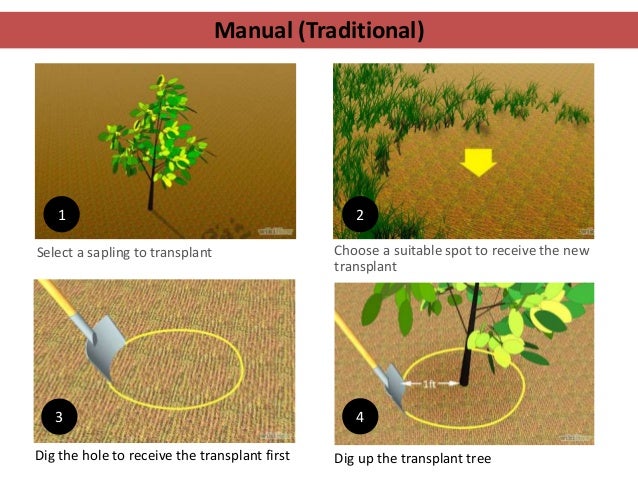
Tips on how to Transplant Shrubs and trees: Step-by-Step Guidance
- Consider the maximal - "Place or Location”. Prior to re-planting or transplant, determine whether the tree or plant favour sun or shadow, and what exactly its space and water requirement are. As an example, do not choose a plant that will craves water next to the one that prefers dried conditions : the requirements will be incompatible.
- Get the new pit dig before you dig out the tree/plant for transplant. Once you dig out the plant, often the longer it has the roots head out without a ground, the lower the odds for survival of transplanting will likely be.
- Determine or calculate the size and detail of the root-ball. The actual width from the new pit should be two times that of the actual root-ball. Often the depth must be kept somewhat shallower, to prevent pudding as well as consequent aging (especially in case your soil is clay-based).
- After digging, whenever you reach the base of the new hole, DO NOT break in the soil underneath. You would feel that this would help the tree or perhaps shrub, enabling its root base to enter deeper. Rather, it could trigger the woods or plants destroy and invite decay.
- Seek out the plant chosen for re-planting. But do not begin digging at the base of the fully developed tree / plant. Relatively, begin digging about three or more feet out of the base, all of along the circumference. Get a sense for the location where the main Size of Root beginning lies. Additionally begin to determine what the body mass will be of the plant as well as the roots in addition to the soil adhering to root base. You may need anyone to help you raise it.
- The concept is to maintain as much of the actual root-ball (roots plus soil) intact as you can. Nevertheless the larger plant is, the probability of getting something close to the complete root-ball may reduce and you will not be able to put it anyhow. Typically you will have to trim through several roots of the older plant. Make sure to make a great, fine cut.
- After you have removed sufficient soil through around the edges of the plant, you will finally be able to slide your spade (scoop) under this and begin to loosen the actual plant's grasp on the ground below it. After soil is loosen, spread a tarp (cover, sheet) on the ground very close by and softly move the particular tree or shrub on to the sheet.
- While using tarp as being a carrying method, move the plant over to the new dug pit (steps 1-4). Carefully shift it to the hole, and place it upright. Put back the actual unearth soil back into the opening and fill it. Stamp this particular soil straight down firmly as well as water it, to get rid of air sack. The development of air flow pockets might lead to the tree or plant to shift it position and loosen it grip on the ground.
- Pile up the earth in a group around the newly shifted tree or plant, forming the sink which will hold water like in a container. This will assist you to achieve your primary objective to get the newly relocate roots nicely watered, until it finally becomes settled.
- Get spread around a 1-2-inch layer of manure towards newly relocate tree. But maintain it a few long away from the ground trunk, to promote air flow and also not to invite rats/pest with gnaw over the trunk.
- Next very important task is to only Water. The initial summer would be a difficult for the tree to fight the weather condition, provided the tree gets a lot of water. For any tree transplant, Watering is one of most vital step, to make any transplanted tree survive and get success.
Best time to Plant or Transplant a Tree/Plant
It is recommend from June & upto Oct-Nov for planting
any sort of tress particularly in India. Monsoon will help but one must be willing and
ready to water.
Reason: 1. There is certainly sufficient rain water to take care
of the trees.
2. The temperatures is also reasonable and does not burn off the new plant/tree
3. It develops adequately in order that it can survive the harsh summer time.
2. The temperatures is also reasonable and does not burn off the new plant/tree
3. It develops adequately in order that it can survive the harsh summer time.
As far as the Climate in India, one plant trees any time
provided sufficient water
is available. So do not delay or postpone tree plantation.
Your plant matters, but how you
plant and quality of saplings matters as well.
By CGAN

No comments:
Post a Comment